

Many advertisers understand value-based bidding in theory. Far fewer have the signal quality to make it work, and the difference comes down to conversion data.
That matters more than it used to. In automated PPC bidding, spam does not just waste budget; it becomes training data. Imperva recently reported that 53% of internet traffic is from bots, while Anura estimates that 1 in 4 paid leads is fake.
If fake form fills or low-quality leads get assigned real value, Google can learn to chase the wrong traffic. That is why the signal behind value-based bidding matters so much: When spam enters the data set as a valuable conversion, it can drag performance back toward volume-bidding behavior after an early lift.
Value-based bidding optimizes toward whatever is designated as valuable, a step that is often overlooked in many setups. Clean data and accurate values point it to your best customers, while incorrect values or unfiltered spam point it to the worst, faster than volume bidding ever would. As WebFX explains below, the strategy is only as good as the signal underneath it.
The data referenced in this article comes from anonymized internal WebFX analyses of paid advertising performance. WebFX's PPC team reviewed campaign and lead-quality data before and after implementing changes to the conversion signals used for value-based bidding, including how lead quality and downstream outcomes were communicated back to the advertising platform.
In one analyzed account, the cost per qualified lead dropped about 47% year over year. That gain came from cleaning the signal fed to the bid strategy, not from the switch itself.
Value-based bidding is a Google Ads strategy that optimizes toward the total value of your conversions rather than the raw number of them. Instead of chasing more conversions, it chases more valuable ones.
The difference from volume bidding is the whole point. Maximize conversions and target CPA (cost per acquisition) optimize toward conversion volume, a solid fit when your conversions are similar in value. Maximize conversion value optimizes toward the conversions worth the most, but only if it has been told what each one is worth.
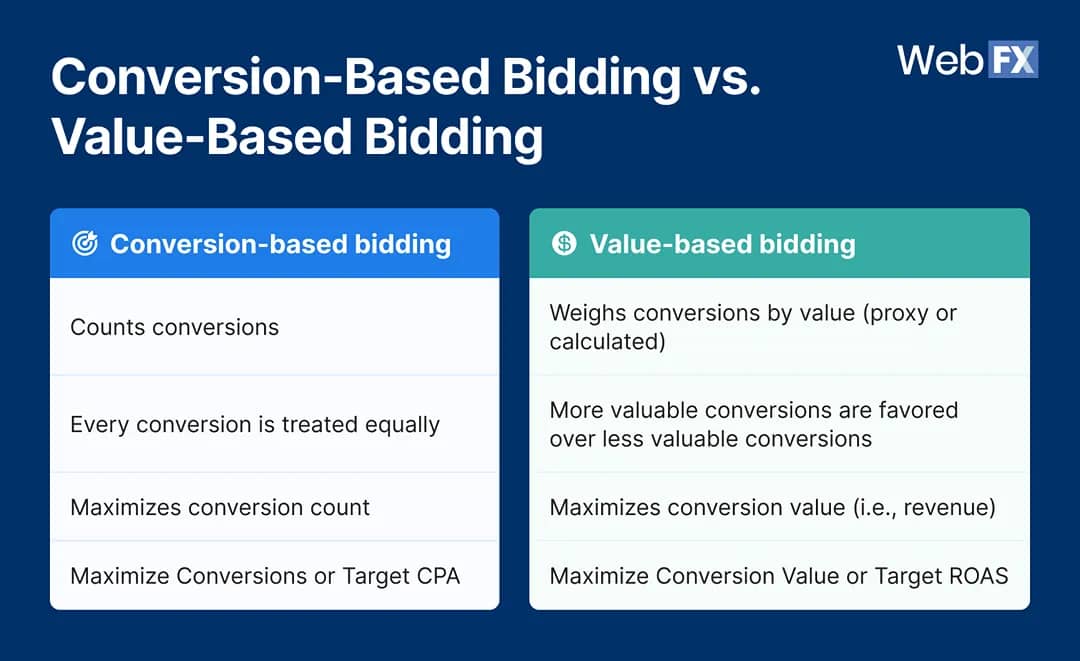
In practice, conversion value bidding is what shifts Google from chasing raw volume to chasing real revenue.
Getting value-based bidding turned on is the easy part. Selecting Maximize conversion value or target ROAS (return on ad spend) allows the strategy to run. What decides whether it works is the quality of the values and data fed to it. Many implementations prioritize the strategy while neglecting the underlying signal.
Most value-based bidding strategies underperform because the conversion signal feeding the algorithm is messy, incomplete, or misleading. The bidding strategy itself is rarely the problem. Google’s system does what you tell it to do, so when the results are bad, the instructions are usually the reason.
Here are the failure modes commonly seen:
This does not necessarily mean a team did something wrong. It is accumulated debt, the residue of old tests, quick fixes, and conversions nobody wanted to touch. Most accounts more than a couple of years old look like this, and all of it is fixable once you know what to look for.
Messy conversion data is any conversion signal that misleads Google about who your best customers are, whether by telling it something false or leaving out what makes a lead valuable. It is the root cause behind most of the failure modes above, and it is more common than most advertisers realize.
A few patterns recur in real accounts.
Every one of these teaches Google the wrong lesson. Google Ads spam and bot spam are the clearest examples, because the algorithm cannot tell a bot’s form fill from a real one. It just sees a conversion and goes looking for more like it. Clean the data, and conversion value bidding finally has something honest to learn from.
Fixing value-based bidding comes down to three moves: Consolidate your conversion signal, let values update as leads progress, and remove spam instead of just discounting it. Together, they give Google one clean, honest picture of what a good customer looks like.
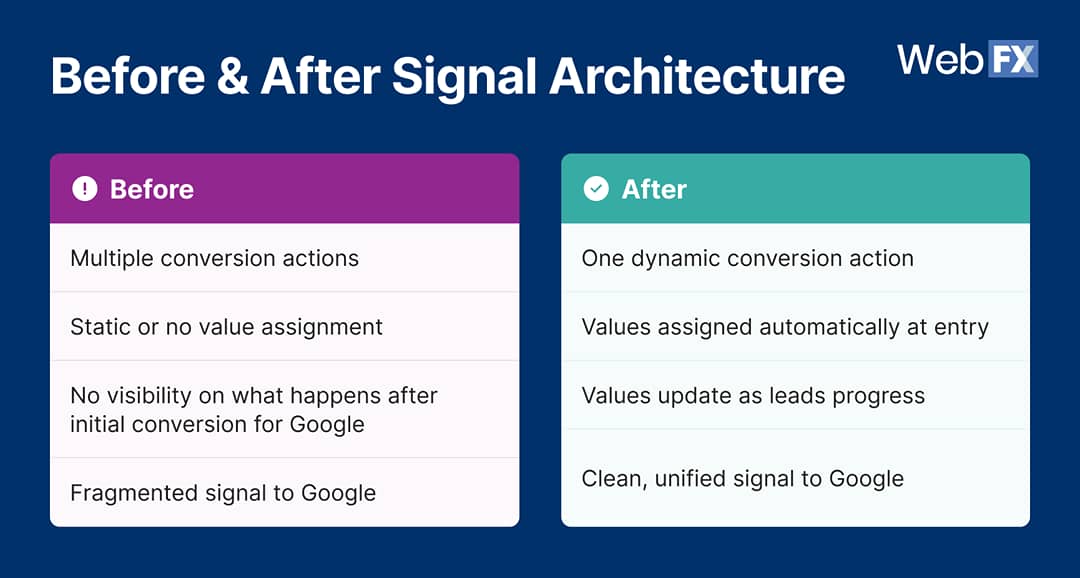
Consolidate around one authoritative conversion action
Google needs one clean source of truth, not a scattered set of primary conversions all competing for importance. The fix is to route everything through a single conversion action that fires across your real conversion events.
That one action carries a value that changes as the lead advances. What most advertisers miss is that tracking the lead, qualified, and closed stages as separate conversion actions causes Google to read them as three unrelated wins, rather than a single lead maturing. Turning them into updated values on a single action fixes that, so Google sees a single lead moving through the pipeline.
This is important because the algorithm cannot tell which of a dozen primaries is the real north star. Disjointed events and data, even when coming from event data that you think is valuable, dilute the training data the same way it would in any model. To achieve effective value-based bidding, the bidding algorithm cannot have competing priorities. Valuable actions must be unified, and impact communicated via conversion-value adjustments, not separate events.
Let conversion values update as leads progress
Conversion value bidding is only as good as the values behind it, so a value should reflect what a lead is actually worth, rather than a number you set once and forget. When a lead enters, it gets an initial value. As it qualifies and closes, that value updates on the original record, so your conversion counts stay clean while the signal gets richer.
Timing is the catch. The bidding model only learns from value updates that reach Google inside a seven-day window from the original click. For B2B cycles that run 60 to 90 days or longer, the deal closes long after that window shuts.
The workaround is to assign meaningful values early, based on the funnel stage versus the final outcome. What matters most is the relative weighting, not the exact dollar figure. A quote request should take precedence over a newsletter signup from the moment it comes in, and Google needs to know that on day one.
Remove spam from the signal instead of letting it train your bidding
Once a conversion is sent to Google, you can do one of two things with it: Retract it, which pulls it out of the data set entirely, or restate it, which changes its value but leaves the conversion on the record. Which one you can do depends on your setup, and the difference matters.
If a spam lead comes in valued like a real one and you restate it to $0 later, the damage is already partly done. Google saw a valuable conversion and started chasing the pattern that produced it, and restating after the fact does not completely undo what it already learned.
Spam is hard to catch because it rides on your own tracking. A bot clicks your ad, Google attaches its click ID to your landing page URL, the bot fills out your form, and your tracking captures that click ID exactly as it would for a real lead. The fake lead travels the same path as a real customer.
So the fix works on two fronts. Retract spam and disqualified leads where your setup allows it, so the algorithm unlearns the pattern instead of adjusting around it. If retracting is not possible on your setup, then you can assign every new lead a low starting value (i.e., $1), then restate it upward only as it qualifies, or restate it to $0 if spam or unqualified. That way, a lead that enters at a dollar and turns out to be spam never gets valued above a real customer. A flood of low-value spam cannot pull your budget in the wrong direction as badly as a batch of inflated-value conversions would.
Either way, someone has to own a regular lead-quality review, and the catches have to land inside the same seven-day window to affect bidding.
Three issues surfaced during this analysis. Each one informed this approach to value-based bidding, so they are worth walking through.
Once the signal was clean, the results showed up across every important metric. These figures come from accounts tested, not projections. Account names are withheld for confidentiality, and the figures below come from anonymized internal analyses reviewed by the PPC team.
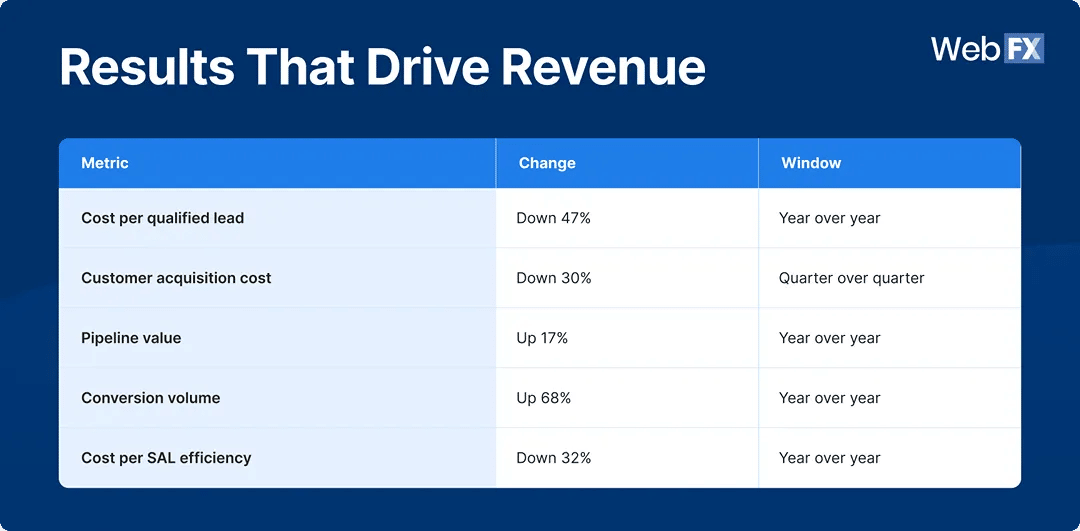
There are a few things to note. On the account where conversion volume jumped 68%, spend more than doubled year over year. Normally, more spend means worse efficiency, yet the cost per sales-accepted lead still improved 32%. The volume grew in large part because of the increased spend, but because of the better efficiency created with this value-based bidding method, the investment dollar stretched much further in driving real revenue and results, even on more than double the budget.
Part of any reported value improvement also comes from better measurement rather than an overnight business change. When you move from placeholder conversion values to numbers that reflect real lead quality, your reported return improves because the math is finally accurate. The volume and cost gains are independent of that, which is why they should lead.
Expect a short adjustment period before the gains show. Google re-enters a brief learning phase whenever the conversion signal changes, so give it two to three weeks to stabilize before you judge the results.
All these gains came from feeding the bid strategy a cleaner signal.
The reason most value-based bidding underperforms is rarely the algorithm. It is that the fixes require coordination across teams that paid search does not control on its own. The setting may only take a minute to change, but the operation behind it takes real alignment.
Look at what each fix actually depends on. Value updates only work if sales moves leads through CRM stages quickly, inside the window Google can still learn from. Spam removal only works if someone owns a standing lead-quality review. Consolidating conversion actions means touching things that look like they are working, which nobody volunteers to do.
That pulls in more people than a change in bidding suggests: Paid media, sales, CRM and data teams, web and analytics, and the revenue leaders who care about the number at the end. None of it is conceptually hard. All of it is organizationally hard, and that gap is where most paid efficiency leaks.
The real shift is that automated, advanced bidding strategies are becoming a commodity that any competitor can, and will, copy. Clean first-party data and accurate conversion signals, maintained as an ongoing discipline, are the parts they cannot.
This story was produced by WebFX and reviewed and distributed by Stacker.


